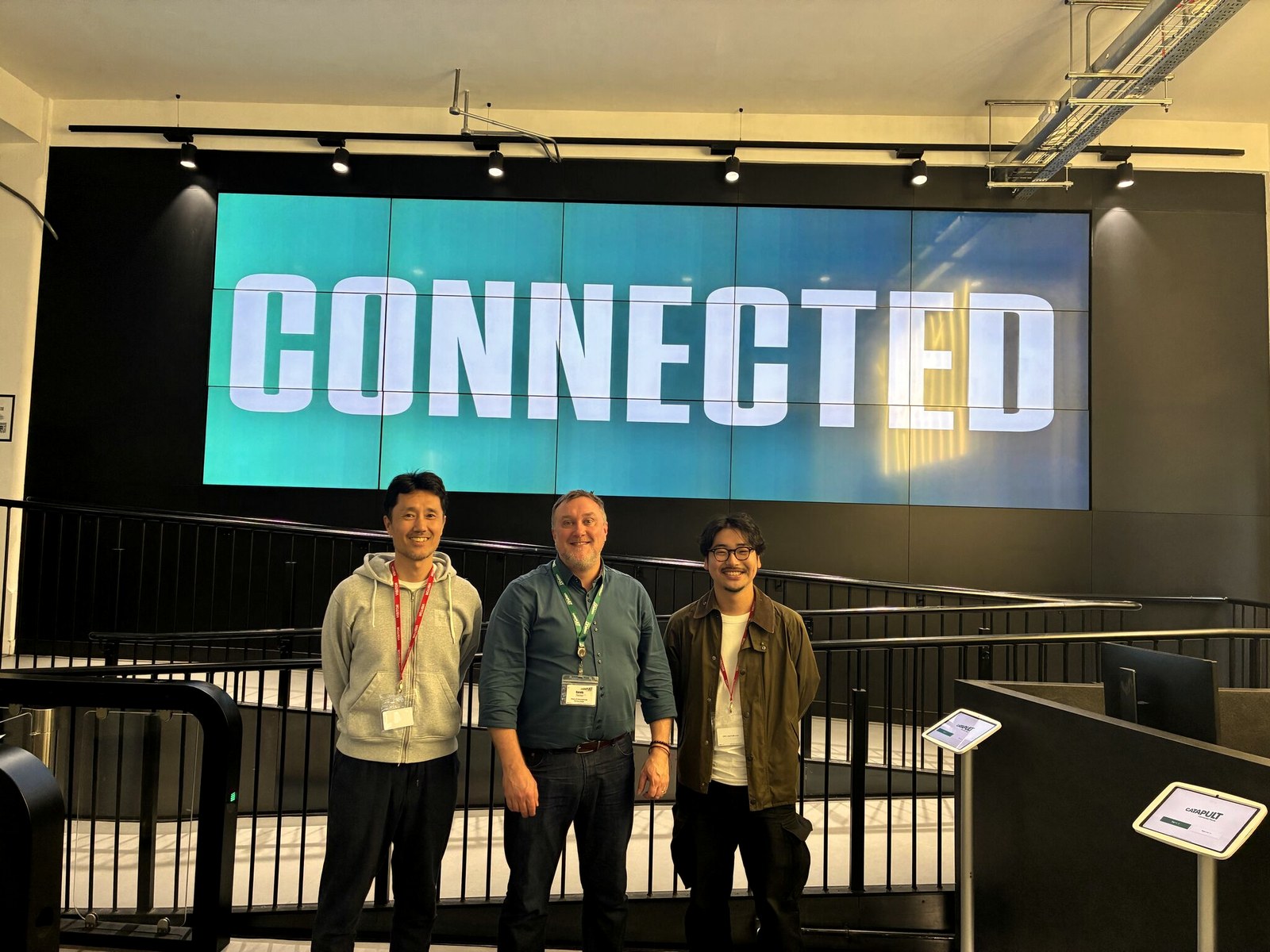
A paper co-authored by our CEO, Tomokazu Iwabuchi — "Study on Initiatives to Promote Innovation Districts in Regional Cities through International City-to-City Collaboration: Case Study in Fukuoka City and Kitakyushu City Based on Collaboration with the UK's Connected Places Catapult" — has been published in No. 24 (February 2026) of the Reports of the City Planning Institute of Japan. It is based on joint research by Nikken Sekkei Research Institute, Kyushu University, and Urbanix.
Authors and affiliations
The paper has seven co-authors.
- Liyang Fan, Kota Nakagawa (Nikken Sekkei Research Institute)
- Yushi Yoshida (Nikken Sekkei Research Institute)
- Tomokazu Iwabuchi (Graduate School of Kyushu University / Urbanix Co., Ltd.)
- Masaya Sato, Haruka Kurata (Nikken Sekkei Ltd.)
- Takefumi Kurose (Faculty of Human-Environment Studies, Kyushu University)
The paper's author affiliations list Iwabuchi under both Kyushu University and Urbanix Co., Ltd.
Background
The UK's Connected Places Catapult (CPC) runs the Innovation Twins Program, an international framework pairing regional cities that share similar urban challenges. It proceeds through three phases — evidence-gathering, engagement and relationship-building, and scaling up collaboration — and has expanded from a UK–South Korea pilot in 2020 to Taiwan and then Japan. In August 2024, a CPC report named candidate city pairs for Japan: Cardiff with Fukuoka, and Swansea with Kitakyushu.
Until now, though, this kind of collaboration has mainly paired cities or industries — offshore wind power, semiconductors — rather than being tested at the smaller scale of a single district's placemaking or urban development. This paper sets out to fill that gap: it redefines "international city-to-city collaboration" and examines how it could apply at the district level, through a Fukuoka/Kitakyushu case study.
How this differs from sister-city ties
The paper contrasts this approach with conventional sister-city (friendship-city) partnerships. Those are typically led by municipal administrations, center on goodwill and cultural exchange such as commemorative events and delegation visits, and tend to lack clear KPIs — so simply continuing the relationship becomes the goal in itself.
"International city-to-city collaboration," by contrast, reframes the city as a platform ("City as a Platform"): industry, universities, residents, and startups join government as participants in the collaboration, which plays out through practical activities such as policy dialogue, joint research, business support, and technology trials, with concrete KPIs such as the number of joint projects, investment attracted, or technology adopted. A bridging role called the "Enabler" — played by CPC itself within the Innovation Twins Program — connects these actors to each other.
The Fukuoka/Kitakyushu case study
Taking a cue from the UK's own "UK Innovation Districts Group" network, the paper adopts "Innovation Districts (IDs)" as a shared Japan–UK theme, and independently identifies four districts in Fukuoka and Kitakyushu with the potential to grow into IDs: Tenjin/Hakata, Hakozaki, the Kitakyushu Science and Research Park, and Wakamatsu. It then works through candidate pairings with UK IDs, judged on location and development type, overlap in existing or emerging industrial themes, and key stakeholders and ecosystems — for example, Tenjin/Hakata with the Birmingham Knowledge Quarter, Hakozaki with Queen Elizabeth Olympic Park, the Kitakyushu Science and Research Park with Newcastle Helix, and Wakamatsu with the South Wales Industrial Cluster and Cardiff City Region Energy Park.
UK site visits, and the "Anchor" and "Enabler" concepts
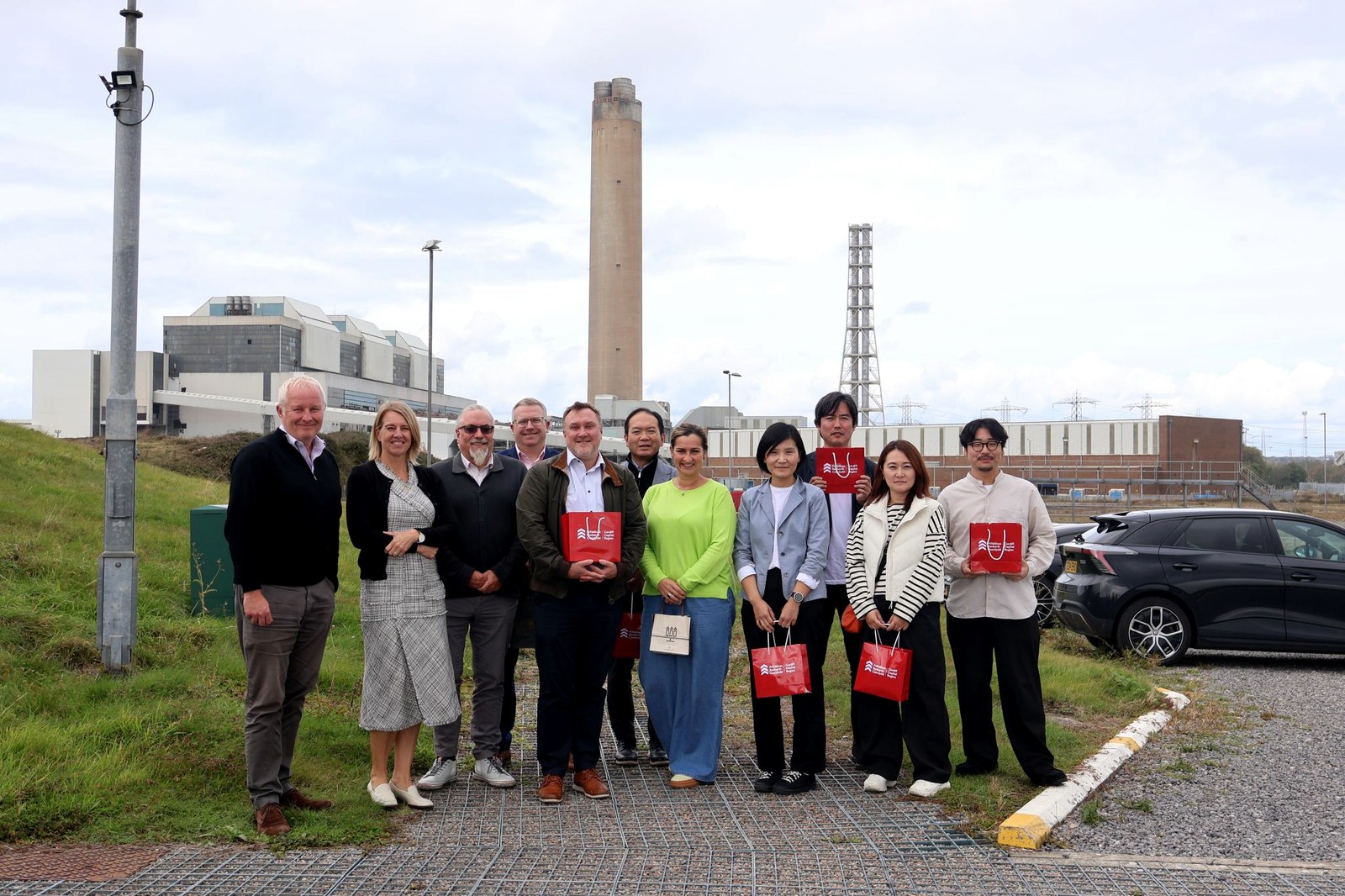
Touring the site as it is redeveloped into a renewable-energy hub
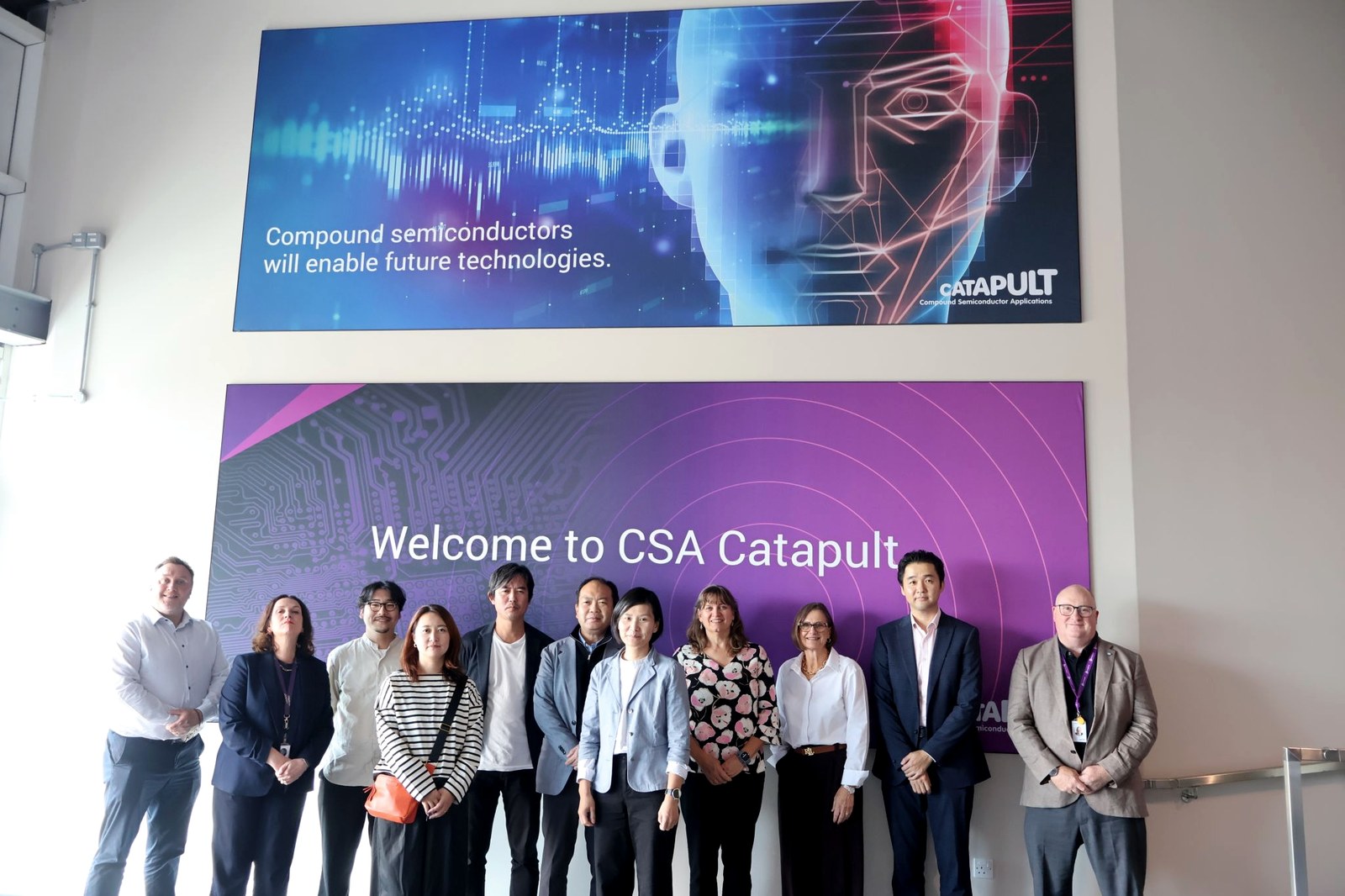
A compound-semiconductor applications hub, seen firsthand as an Anchor/Enabler example
From September 15 to 19, 2025, the team visited major UK Innovation Districts in person. Beyond the surface-level clustering of companies or formal industry–academia–government ties, they found a functional interplay they describe through two concepts: the "Anchor" — universities, major hospitals, research institutions, or global companies that serve as the gravitational source of a district's identity and credibility — and the "Enabler," the catalytic function that connects an anchor's resources to business and real-world problem-solving, including building networks with overseas innovation districts, attracting foreign companies and investment, and running startup support programs. In the UK cases, these two roles are strategically tied together under shared masterplans and KPIs set by local government.
For Japan, the paper suggests that while Fukuoka and Kitakyushu already have anchor institutions — universities and research bodies — they lack a mature "global enabler" function to connect those institutions' technology and talent to overseas investment and business, making the direct transfer of UK know-how potentially valuable. It also points to UK districts' "living lab" and "testbed" approaches — opening up the city itself as a site for real-world trials — as a model worth importing.
Sharing the work at a symposium
On December 5, 2025, the team held a symposium in Fukuoka, "Accelerating Innovation through International City-to-City Collaboration," co-hosted with CPC, the Kitakyushu Foundation for the Advancement of Industry, Science and Technology (FAIS), Kyushu University OIP, and the Fukuoka Directive Council (FDC). Speakers included Urbanix, Kitakyushu City, Kyushu University, Nishi-Nippon Railroad, Nikken Sekkei, and Nikken Sekkei Research Institute, and more than 100 people attended in person and online. In a post-event survey (13 respondents), over 90% said they were satisfied or very satisfied; the session on the current state of innovation districts in Fukuoka and Kitakyushu drew the most interest, while the sessions on international city-to-city collaboration itself also drew strong interest from attendees working in real-estate development, government digital transformation, and international partnerships.
Conclusions and next steps
The paper's conclusions: it (1) clarified the definition and significance of "international city-to-city collaboration" based on the CPC's Innovation Twins Program; (2) set Fukuoka and Kitakyushu as case-study sites, adopted Innovation Districts as a shared theme, and trial-paired them with UK districts; (3) clarified, through on-site research in the UK, the Anchor and Enabler roles and the importance of ecosystems for advancing IDs; and (4) confirmed, through a Fukuoka symposium and dialogue with speakers and attendees, the potential for international city-to-city collaboration in district-level placemaking. The authors plan to keep working with CPC and the symposium's municipal, academic, and corporate participants to advance concrete district-level collaboration.
Urbanix's connection to this work
Since 2023, Urbanix has served as the Japan-side partner in the CPC's Innovation Twins Program linking Kitakyushu City with Wales, covering everything from hosting delegation visits to agreements, joint research, and student exchange. This paper is, in effect, an academic organization — by Iwabuchi in his capacity as a Kyushu University researcher — of the insights accumulated through that on-the-ground collaboration. More on the background and specific activities of this partnership can be found on our International City-to-City Collaboration project page. The paper's acknowledgments also thank Gareth Davies of CPC for his full cooperation with the UK site visits and the symposium.
Keywords
The paper lists five keywords: international city-to-city collaboration, innovation districts, ecosystem, anchor, and enabler.
Urbanix will keep connecting the insights gained through on-the-ground practice to academic inquiry, as we continue working to help regional cities pursue industrial transition and placemaking together. For inquiries, please use our contact form.
Source
Liyang Fan, Yushi Yoshida, Tomokazu Iwabuchi, Masaya Sato, Haruka Kurata, Kota Nakagawa, Takefumi Kurose, "Study on Initiatives to Promote Innovation Districts in Regional Cities through International City-to-City Collaboration: Case Study in Fukuoka City and Kitakyushu City Based on Collaboration with the UK's Connected Places Catapult," Reports of the City Planning Institute of Japan, No. 24, City Planning Institute of Japan, February 2026, pp.785–791
View on J-STAGE ↗
Note: the Reports of the City Planning Institute of Japan is a report series without a peer-review process.